Don't try this alone! Here is the idea of Pre-Texts; to join the practice, find a Weaver for training.
Ice-Breakers
(approx. 3 min.)
Playful exercises designed to relax inhibitions, break the ice and get us used to making silly mistakes.
Inspired by Augusto Boal’s Games for Actors and Non-Actors,
warm-ups generate a safe space of trust and cooperation.
• Bok Center for teaching and Learning, Harvard University, March 2016
1. Read the text aloud while participants make something
(approx. 5 min.)
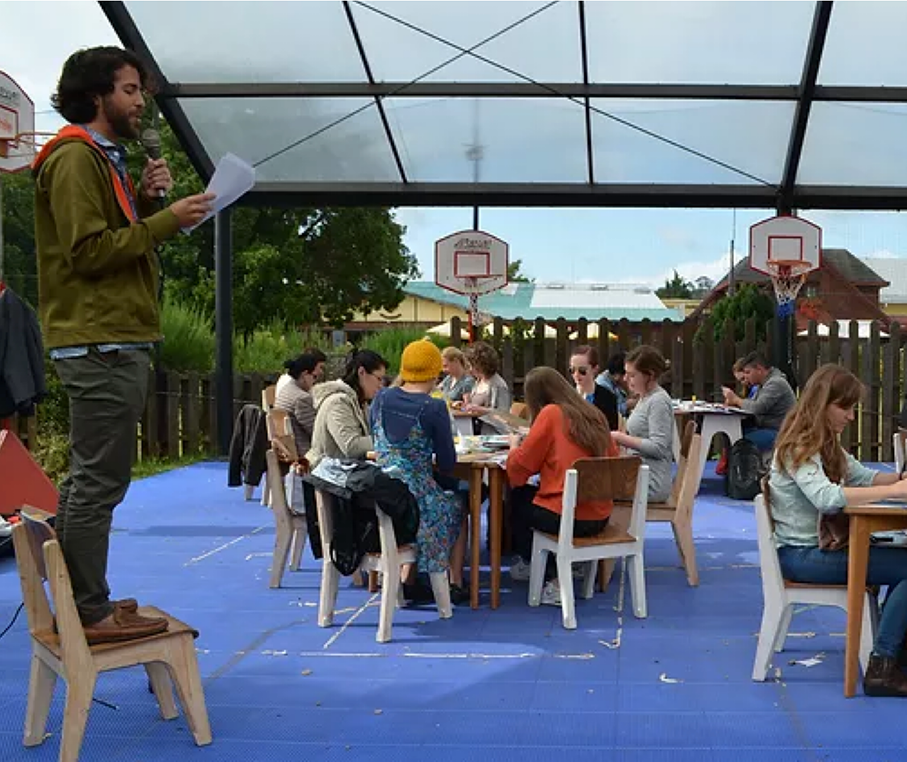
A volunteer reads a target text aloud (something from a required list, difficult or “boring” to prepare the feeling of mastery through art-making later) while others draw or doodle. The combined listening and illustration takes advantage of two Latin American practices: the “lectores” whom tobacco rollers hired to read newspapers, Shakespeare, Marx, etc. for enjoyment and popular education. Factory lectors 1910 and Cartonera publishers who recycle used cardboard into books, Editoriales Cartoneras
• Global leaders program (social entrepreneurs of music), Frutillar, Chile. January 2018
2. Ask the text a question
(approx. 20 min.)
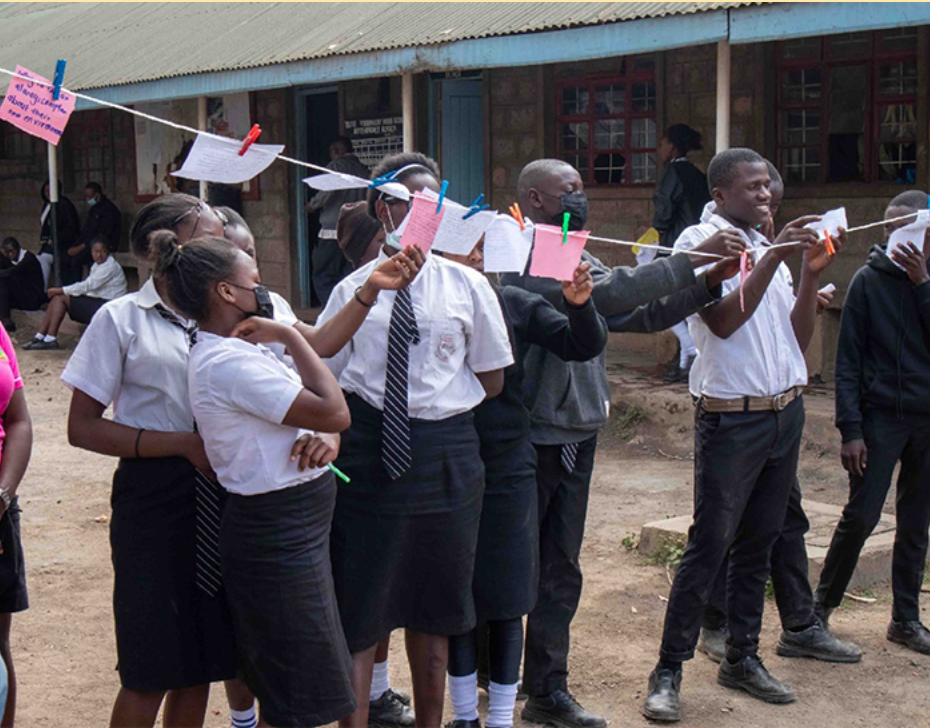
Each person asks the text a question (approx. 8 min.) This is the core of critical thinking. Texts, not students, are objects of scrutiny. Students are interrogators who cultivate curiosity, and discovery. Copies of the text
are made available to consult, not distributed. We want to generate students’ desire for the text since they will have to ask and post questions. The variety of perspectives and interests appear published anonymously on the clothesline to show that reading always interprets and that difference is not error.
2a. Respond to a question (approx. 8 min.) Each participant “adopts” a question and responds, as practice in writing and civics. Returning the questions
with responses to the clothesline, students read each other.
2b. Main points lingering doubts (approx. 4 min.) Facilitator asks for salient points; first speaker invites the next and the “chain” of speakers ends with
“Ready for artmaking!”
Cordel

• With 9th graders at the “Elite” school in Kiberia, Nairobi, Kenya. November 2021
3. Make art from the text
(approx. 25 min.)
Participants take turns to facilitate an arts activity based on the target text. After the first session
students or guests can facilitate. The creative
activity can be irreverent: jokes, fashion shows,
riddles, comics, recipes, etc. but using the text as
material. Teacher or student facilitators propose
a genre of art or an approach and then they invite
everyone to offer questions and recommendations
in order to co-construct the activity. This is an
exercise in consensus building and an opportunity
to recover local arts, languages, and practices,
to decolonize education even when using texts
from colonial centers.
Video: Kalmadi 8th Grade reads Chekhov, The Beggar
• Dramatization of “The Beggar by Chekhov by 8th graders in the Kalmadi School, Pune, India
4. Form a circle and ask “What did we do?”
(approx. 5 min.)
The art-making activity closes with a brief session
to reflect on “What did we do?” Rather than ask the
conventional “What did we learn?” — which often
generates rote, mute, and even hostile responses—
our question animates participation. Artists enjoy
speaking about their process. Each reflection is
limited to a sentence or two, adding interpretation
and theory to art-making. Everyone speaks briefly
before anyone can speak again. This develops good
citizenship.
• Artists and scientists at Dublin´s Technological University, Grangegorman, Ireland, May 2018.
5. Go off on a tangent
(15 min.)
This prompt at the end of a session prepares the
first activity for the next. Conventional teaching
often dissuades students from exploring connections
to a shared text, but we encourage curiosity and
free reading to select a contribution to post.
If students need to tackle books or long essays,
we invite them to go
“off a leaf,”
that is to bring a passage that caught their
attention. On coming to class, each participant
posts a tangent anonymously on the clothesline
and reads the others for about 10 minutes.
Then one reader asks about a tangent; the
contributor speaks to its connection with the
shared text, and chooses another tangent to be
presented. This sampling lasts for 5 minutes,
leaving a desire for more.
• Bahamas National Art Gallery, Nassau, October, 2016
Amoeba Tour. One possible Creative Activity
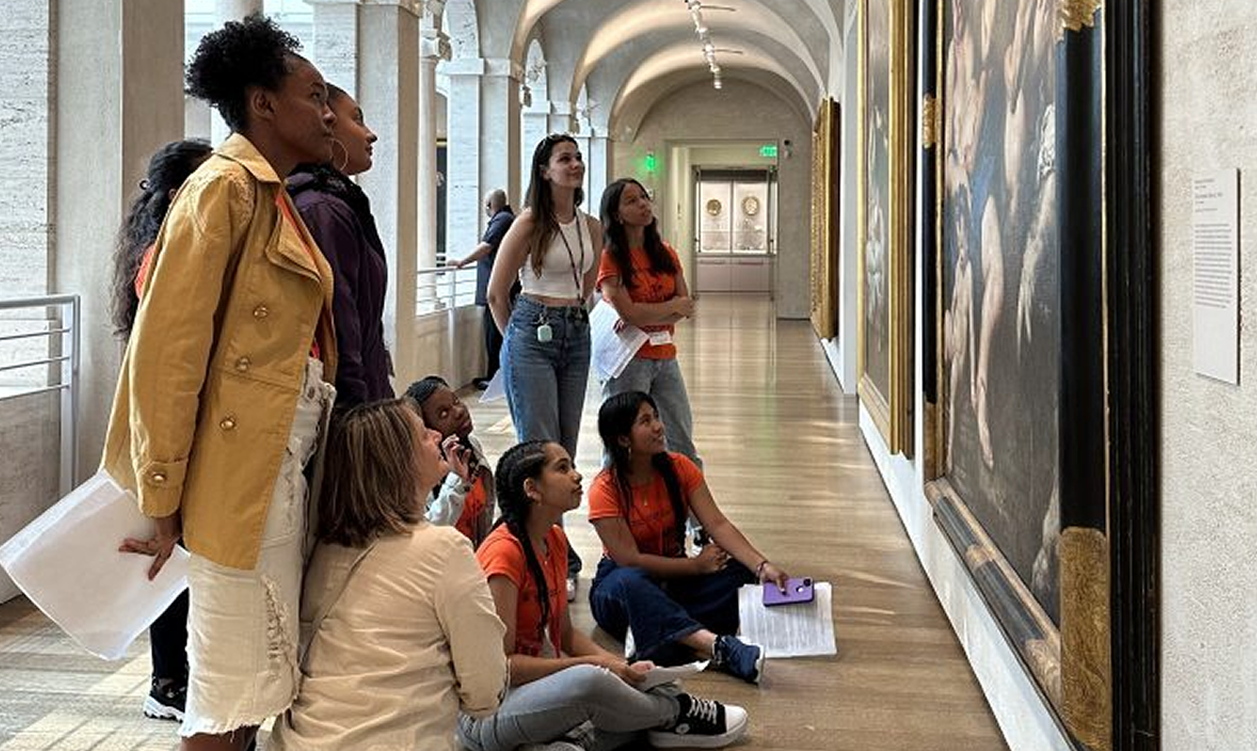
The “Amoeba Tour” is a gallery visit in which each participant is a
guide to an object of their choice. After circulating for a short while, each person adopts an object and
says what connection it has to the text we have just read and interrogated. It’s that simple with profound results. In the process, we:
The Amoeba Tour is one of many possible ways that the Pre-Texts protocol can engage the arts to improve reading comprehension and a love of learning among children, youth, and adults.
Harvard Art Museum, May 23, 2022
• “Cosmos” by Carl Sagan, with Afro-Colombian teens and the Ministry of Science and Technology, at the Harvard Art Museums, May 23, 2022.